
What is a solar eclipse and why do they happen?
A solar eclipse is simple geometry: the Moon passes directly between Earth and the Sun, casting its shadow onto Earth's surface. What varies, and what makes each eclipse different, is how completely that shadow blocks the Sun and how it does so.

There are four kinds of solar eclipse
The type of eclipse you see from any one place depends on the alignment of the Sun, Moon and Earth, and on the Moon's distance from Earth at the time, since its orbit is not perfectly circular.
Total eclipse
The Moon fully covers the Sun's bright disc, revealing the corona, the Sun's faint outer atmosphere, which is normally invisible in daylight. Totality is only visible along a narrow path on Earth's surface, typically 100 to 250 kilometres wide, and usually lasts a few minutes at most.
Annular eclipse
The Moon is too far from Earth in its orbit to cover the Sun completely, leaving a bright ring, or "ring of fire", visible around its edge. Because the Sun is never fully blocked, safe solar filters are required throughout an annular eclipse, with no exception.
Partial eclipse
The Moon covers only part of the Sun's disc. Partial eclipses are visible over a much wider area than totality or annularity, and every total or annular eclipse is preceded and followed by a partial phase across the surrounding region.
Hybrid eclipse
A rare case in which the same eclipse appears total along one part of its path and annular along another, because the curve of Earth's surface brings some locations slightly closer to the Moon's shadow than others.
Duration;
Why do some eclipses last longer than others?
Totality can last anywhere from under a second to a theoretical maximum of 7 minutes 32 seconds. No eclipse in recorded history has reached that ceiling; the longest of the 21st century, on 22 July 2009, ran to 6 minutes 38.86 seconds. Several factors stack together to produce that range, and most eclipses fall well short of the maximum because the conditions rarely align in the same direction at once.
The Moon's distance from Earth
The Moon's orbit is an ellipse, not a circle, so its distance from Earth varies between about 356,500 km at perigee (closest) and 406,700 km at apogee (farthest), a swing of roughly 14% in apparent size. A total eclipse needs the Moon's disc to appear larger than the Sun's, so eclipses near lunar perigee produce longer totality, while eclipses nearer apogee produce shorter totality, or fail to reach totality at all and become annular instead.
Earth's distance from the Sun
Earth's own orbit is elliptical too, varying between about 147.1 million km at perihelion (early January) and 152.1 million km at aphelion (early July), a much smaller swing of around 3.4% in the Sun's apparent size. It matters less than the Moon's distance, but it still tips the balance: the longest possible totalities occur when the Moon is near perigee at the same time Earth is near aphelion, since the Sun then appears at its smallest just as the Moon appears at its largest.
Time of day and latitude
Totality lasts longer where the Moon's umbra moves slowest across the ground, and that speed depends on how much Earth's own rotation helps or hinders it. Near the equator around local solar noon, the ground beneath the eclipse is moving in nearly the same direction as the umbra at close to its fastest rotational speed, subtracting from the shadow's speed relative to the ground and stretching out totality. Eclipses at sunrise or sunset, or at high latitude, lose most of that benefit, since the ground is moving more across the shadow's path than along it, so totality there is comparatively brief.
Distance from the centre line
Totality is longest exactly on the centre line of the path and shortens the closer you are to its edge, reaching zero at the edge itself. See "Centre line or the edge of the path?" below for what that trade-off actually looks like in practice.
Position within the Saros family
Every Saros series evolves gradually over twelve centuries or more, from an opening run of small partial eclipses, through millennia of central eclipses that lengthen and then shorten again, before closing with another run of partials. Where a given eclipse sits within that arc has a real effect on its duration; a total eclipse from near the middle of a long-running series, when the geometry is closest to ideal, will typically last longer than one from nearer either end. See "The Saros cycle" below for how this plays out across a full family, using the 12 August 2026 eclipse as an example.
The 12 August 2026 eclipse illustrates several of these factors working against maximum duration rather than for it: the Moon is well past perigee, and totality is confined mostly to high latitudes in the North Atlantic in the early evening, all of which shorten it. That is why its 2 minute 18 second maximum sits well below the 6 to 7 minute totalities possible when the geometry is more favourable, such as the 2 August 2027 eclipse, which benefits from a near-midday crossing closer to the equator.
Where to watch from;
Centre line or the edge of the path?
Beyond weather, where you stand within the path of totality changes what you can see, a point made in detail by eclipse cartographer Xavier Jubier, a member of the International Astronomical Union's Working Group on Solar Eclipses.
Standing on the centre line gives the longest possible totality at that longitude, but the chromosphere, the reddish layer of the Sun's atmosphere just above its visible surface, is only exposed for a few seconds there. Move towards the edge of the path instead, and the Moon's disc grazes the Sun's edge far more slowly: the chromosphere can stay visible for 90 seconds or longer, the fleeting "shadow bands" that ripple across the ground beforehand are more likely to appear and last two to five times longer, and the diamond ring and Baily's beads effects, the last beads of sunlight breaking through lunar valleys, can last up to ten times longer, with several beads forming and fading in sequence rather than just one or two.
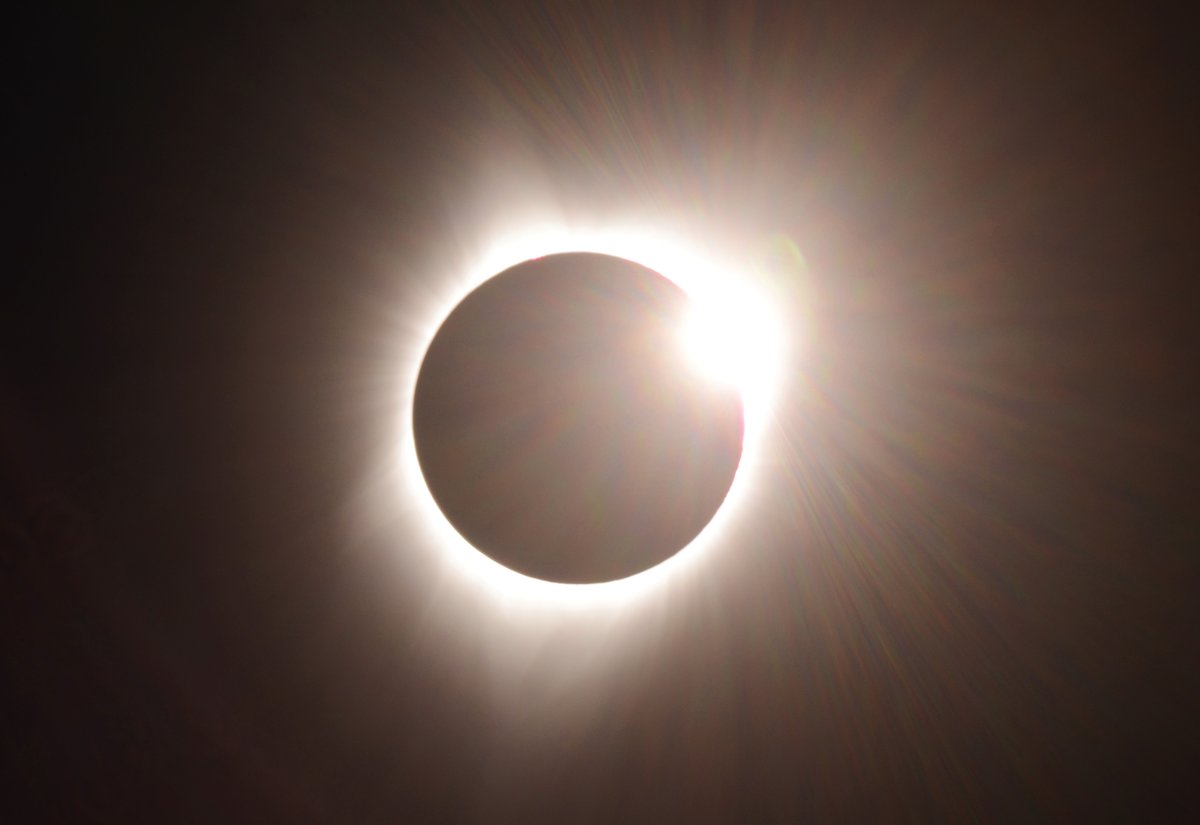
The trade-off is smaller than it sounds. Moving up to 20% of the way from the centre line towards the edge of the path typically shortens totality by only around 2%, since the exact duration at any point also depends on the Moon's uneven limb, its mountains and valleys, rather than distance from the centre line alone. Many experienced eclipse watchers therefore favour a position around 5% in from the edge of the path, trading a totality of roughly a third of the maximum for a longer, richer view of the Sun's edge effects.
It's about shadows;
Umbra, penumbra and antumbra
The Moon casts two, and sometimes three, distinct kinds of shadow, and which one falls on you determines what you see.
Umbra
The dark, central cone of the Moon's shadow. Anyone standing inside it experiences totality, with the Sun completely hidden.
Penumbra
The broader, lighter outer shadow surrounding the umbra. Observers here see a partial eclipse, the depth of which depends on how close they are to the umbra's edge.
Antumbra
Where the Moon is too distant for its umbra to reach Earth, its shadow narrows to a point before Earth's surface and then widens again. Observers within this extended shadow, the antumbra, see an annular eclipse rather than a total one.
Where, when, and how often?
The Saros cycle
Eclipses are not random. They recur in a pattern first recorded by Babylonian astronomers and now known as the Saros cycle, a period of approximately 18 years, 11 days and 8 hours after which the Sun, Moon and Earth return to a very similar relative geometry.
Each Saros cycle contains a family of related eclipses, spaced roughly one Saros apart, that gradually shift in path and character over centuries as the alignment slowly drifts. A complete family runs for 1,226 to 1,550 years and produces somewhere between 69 and 87 eclipses, most commonly 70 to 73, according to NASA's Fred Espenak, who compiled the definitive catalogue of every series. A family always opens and closes the same way: it begins with a run of small partial eclipses near one of Earth's poles, gradually builds through several dozen central eclipses, annular, total or sometimes both, as the geometry shifts, and finally tails off into another run of partials near the opposite pole before the family ends for good.
At any given time, about 40 Saros families are simultaneously active, each roughly 18 years apart in when it next produces an eclipse, which is why a single year can see anywhere from two to five solar eclipses, always drawn from different families since the same family only repeats every 18 years. Five in one year is rare: the last time it happened was 1935, and it will not happen again until 2206. Astronomers use these series to predict eclipses many centuries in advance with high precision, since the underlying orbital mechanics are well understood and well tested against the historical record.
Worked example: the 12 August 2026 eclipse belongs to Saros series 126. The family began with a small partial eclipse on 10 March 1179 and will run until a final partial eclipse on 3 May 2459, a span of 1,280 years and 72 eclipses in total. The 2026 eclipse is the 48th member of that family, preceded by a total eclipse on 1 August 2008 and followed by another on 23 August 2044, each exactly one Saros, 18 years 11 days and 8 hours, apart. Series 126 is currently in the central, total-eclipse-producing portion of its life; earlier members were annular, and later members will eventually shrink back to partial before the family ends.
Viewing an eclipse safely
The Sun is dangerous to view directly at every stage of a partial or annular eclipse, and during the partial phases before and after totality in a total eclipse.
Looking directly at the Sun, even when most of it is covered by the Moon, can cause permanent retinal damage within seconds. The retina has no pain receptors, so damage can occur without any sensation of discomfort.
Certified solar filters
Eclipse glasses and handheld solar viewers should meet the ISO 12312-2 international safety standard, printed on genuine products. Inspect them for scratches or pinholes before use, and discard any that are damaged.
Pinhole projection
A simple and effective indirect method: pass sunlight through a small hole in card onto a second surface, projecting a safe image of the Sun's crescent without looking at it directly.
Filtered telescopes and binoculars
Any optical instrument used to view the Sun, including telescopes, binoculars and camera lenses, needs its own certified solar filter fitted over the front aperture. Eclipse glasses alone do not provide adequate protection when used with magnifying optics.
The exception: totality itself
During the brief minutes of total eclipse, when the Sun's bright disc is completely covered by the Moon, it is safe to view the corona directly with the naked eye. Filters should go back on the instant the first bright sliver of Sun reappears.